





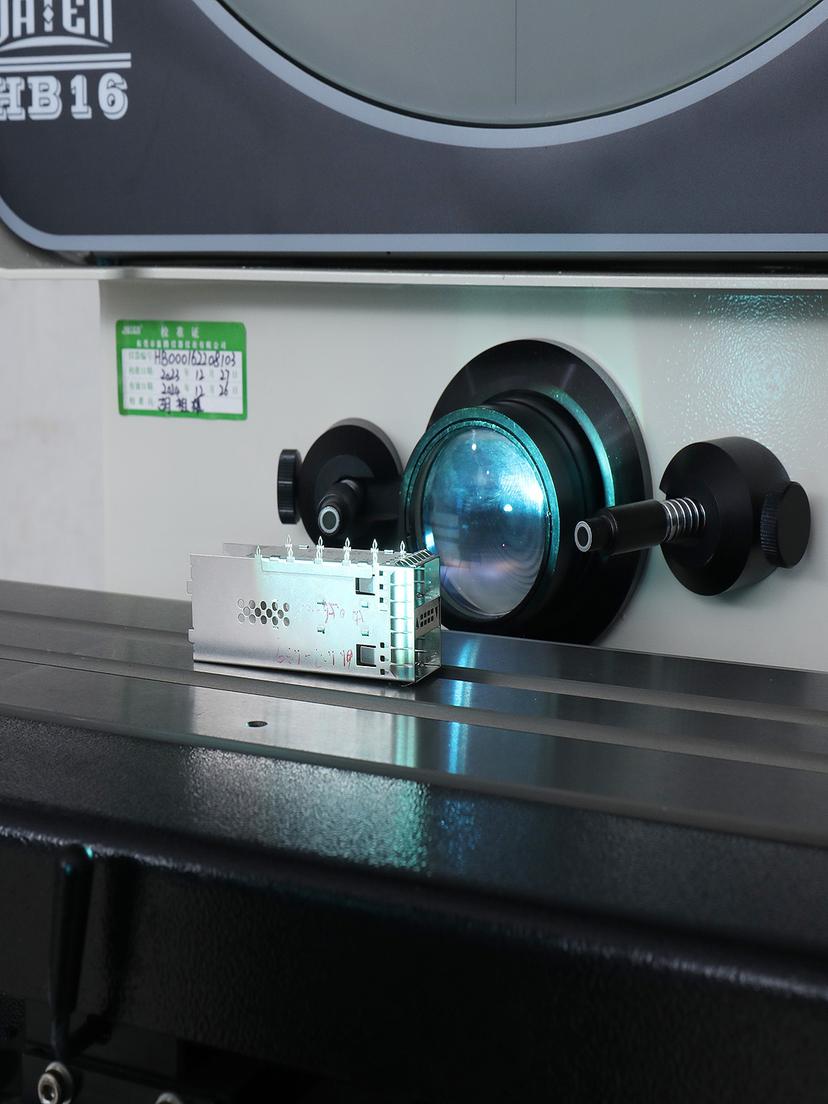
A profile projector (also known as an optical comparator) comes in two configurations: horizontal and vertical. The two differ in optical path, load capacity, typical workpieces, and application scenarios. Choosing the wrong configuration affects inspection efficiency, measurement accuracy, and even operator posture. This article compares them across six dimensions to support a more informed selection.
1. Optical Path and Viewing Orientation
Horizontal profile projectors use a light path that runs horizontally: the light source is on one side, the workpiece lies on its side on the worktable, and the projection screen is on the opposite side. The operator views the screen head-on. This side-on observation suits parts whose critical features are on the side profile — radial features on shafts, gear tooth profiles, and similar features.
Vertical profile projectors use a vertically oriented light path: the light source is below the workpiece, and the projection screen sits above (or in front, in some models). The workpiece lies flat, and the operator views the screen from above or from the front.
The difference in light path means horizontal projectors suit parts defined by their side profile (shafts, gears), while vertical projectors suit parts defined by their planar outline (thin stampings, terminals, flat parts).
2. Load Capacity and Mechanical Structure
Horizontal projectors generally offer higher worktable load capacity. The JATEN JTDHB12 and JTDHB16 share a 408×126 mm worktable; the JTDHB24 enlarges the table to 455×126 mm and pairs it with a larger projection screen (400 mm or 600 mm diameter), suitable for larger or heavier workpieces. The worktable does not move vertically, contributing to structural stability.
Vertical projectors achieve load capacity through their lifting design. Some raise and lower the Z-axis (lens) rather than the table, so the worktable remains stationary. Others elevate the projection barrel, allowing extra-heavy precision parts to be measured without loss of accuracy.
The JATEN JTDHB12 and JTDHB16 have a gross packing weight of 200 kg each (with wooden case); the JTDHB24 reaches 314 kg — substantially heavier than typical vertical projectors, reflecting the structural difference directly.
3. Typical Workpieces and Application Scenarios
Horizontal projectors are typically used for large templates and stampings, gears, threads, form milling cutters, cams, and shaft-type parts — particularly for dimensions or areas that are difficult for vertical projectors to inspect. JATEN positions its horizontal models as an "effective supplement for dimensions and areas difficult for vertical projectors to inspect," making them indispensable in metrology labs, R&D, and complex 3D-part inspection.
Vertical projectors are typically used for terminals, watch components, diamond parts, and other small precision parts; thin and flat precision parts; batch-produced hardware, plastic, and mold parts; PCB connectors and small electronic components. Because the workpiece lies flat and clamps quickly, vertical projectors suit repeatedly measuring small workpieces on production lines and in QC departments.
4. Measuring Range and Accuracy
The two key accuracy specifications — coordinate measurement error of (3+L/200) μm and contour measurement error of less than 0.08% — apply across the JATEN series. There is no inherent accuracy difference between horizontal and vertical configurations.
The real difference is in measuring range (X/Y travel):
- JTDHB12 (horizontal): X/Z travel 200×100 mm; focal travel (Y-axis) 75 mm
- JTDHB16 (horizontal): X/Z travel 300×150 mm; focal travel (Y-axis) 125 mm
- JTDHB24 (horizontal): X/Z travel 300×150 mm; focal travel (Y-axis) 125 mm
Vertical projectors offer a smaller but compact range, suited to small-part inspection. Match the model range to the largest workpiece. Screen diameter is another parameter — 300 mm for the JTDHB12, 400 mm for the JTDHB16, and 600 mm for the JTDHB24. A larger screen displays a larger workpiece contour at one time, which favors larger-part inspection.
5. Footprint and Operator Posture
Horizontal projectors have a longer body in the depth direction (packing dimensions around 1160–1611 mm) due to the horizontal light path. They take more floor space, but the operator views the screen head-on from a seated position, which is more comfortable for long-duration use.
Vertical projectors are compact (typically 0.5–1 m²) due to the vertical light path. They fit well on production-line workstations and inspection benches. The operator must lean over and view the screen from above, which is less comfortable during long, high-volume inspection.
6. Selection Framework
Prefer a horizontal projector when:
- The workpiece is large (typically over 150 mm in X) or is a 3D part, shaft, or gear requiring side observation
- The application is a metrology lab, R&D department, or where the highest measurement accuracy is required
- The operator uses the projector for extended periods each day
Prefer a vertical projector when:
- The workpiece is small, flat, thin, or is a terminal, watch component, or other miniature part
- The application is a production line, QC station, or batch inspection requiring fast clamping
- Floor space is limited and the projector must be placed at the production site
- Budget is a constraint (vertical models are typically priced below equivalent horizontal models)
Both required: For large manufacturers, a common combination is a horizontal projector in the metrology lab plus vertical projectors on the production line. JATEN offers a complete product line covering both configurations — horizontal models (JTDHB12, JTDHB16, JTDHB24) and vertical models (JTD, JTDVB12, JTDVB16) — for a wide range of workpiece sizes and inspection scenarios. See the JATEN profile projector product page for details.