





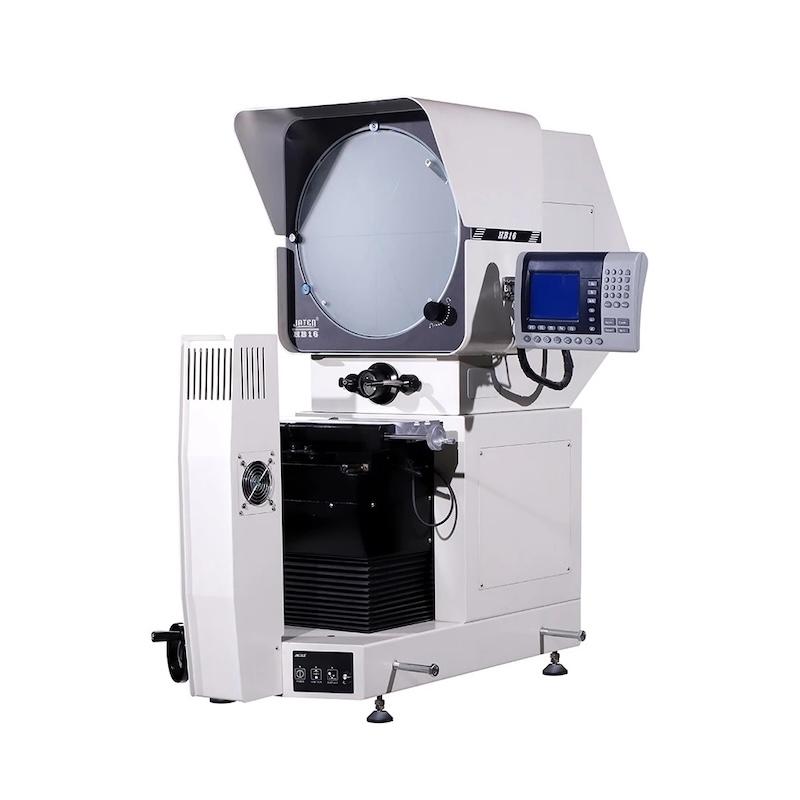
1. Equipment Positioning and Industrial Applications
A horizontal profile projector is a two-dimensional precision measuring instrument based on optical magnification and contour imaging principles. It is mainly used for contour inspection and dimensional comparison of complex geometric parts.
This type of equipment is widely used in machining, mold manufacturing, electronic hardware, tool processing, and precision component industries. It is suitable for inspecting cams, stamped parts, threaded components, terminals, and irregular-shaped workpieces.
In practical applications, the core value of a horizontal profile projector is not simply “magnified observation,” but the ability to compare engineering drawings with actual workpieces through full contour projection, improving the inspection efficiency of complex parts.
2. Advantages of Horizontal Structure in Measurement Stability
The structural design of a horizontal profile projector allows the workpiece to remain in a horizontally supported condition during inspection, which is especially important for long-size components.
For shafts, lead screws, and long cutting tools, vertical systems may be affected by gravity, causing slight displacement or deformation. A horizontal structure effectively reduces these influences and keeps the workpiece closer to its natural machining condition.
This advantage becomes more noticeable in threaded part inspection. Through contour projection, the entire thread profile can be clearly observed, including crest shape, flank angle, and local machining consistency.
In the cutting tool industry, such as form milling cutters or irregular cutting tools, the horizontal structure also makes contour alignment and observation more convenient, improving inspection efficiency and consistency evaluation.
3. Basic Principle of Contour Projection Imaging
The core technology of a profile projector lies in optical edge imaging. The system uses a uniform light source to illuminate the workpiece, creating a clear contrast line at the edge area to achieve visual contour representation.
This process is not simple image enlargement, but a reconstruction of geometric boundaries based on optical edge characteristics. Therefore, image quality mainly depends on the following factors:
Uniformity and stability of the light source
Distortion control capability of the optical system
Surface reflectivity characteristics of the workpiece
In stamped metal parts and precision hardware inspection, this imaging method effectively highlights contour boundaries, making small burrs, deformation, and machining deviations easier to identify.
With a large-screen design, the viewing area becomes wider, helping reduce local misjudgment and improving overall contour evaluation efficiency.
4. Inspection Logic for Complex Contour Parts
In actual manufacturing environments, many components are non-standard geometric structures, such as cams, terminals, irregular stamped parts, and precision cutting tools.
These parts cannot be fully described by a single dimensional parameter, making overall contour comparison more important.
A horizontal profile projector can project the entire contour of the workpiece onto the screen for direct comparison with engineering drawings, allowing inspection to shift from simple dimensional checking to overall shape evaluation.
For example, in the terminal manufacturing industry, slight deviations in bending angles may affect assembly performance. Contour projection enables fast identification of angular changes and edge displacement, improving consistency control in batch production.
5. Summary of Equipment Applications
The main value of a horizontal profile projector lies in providing a more intuitive contour analysis method rather than replacing traditional measuring tools.
Its major advantages include:
Stable inspection of long-size parts
Full contour comparison of complex components
Visual identification of micro defects
Consistency control in batch inspection
In machining and precision manufacturing industries, this type of equipment remains an important part of the basic inspection system, especially in production environments requiring high contour consistency.
Please refer to: https://www.jatentech.com/product/horizontal-profile-projector-jtdhb