





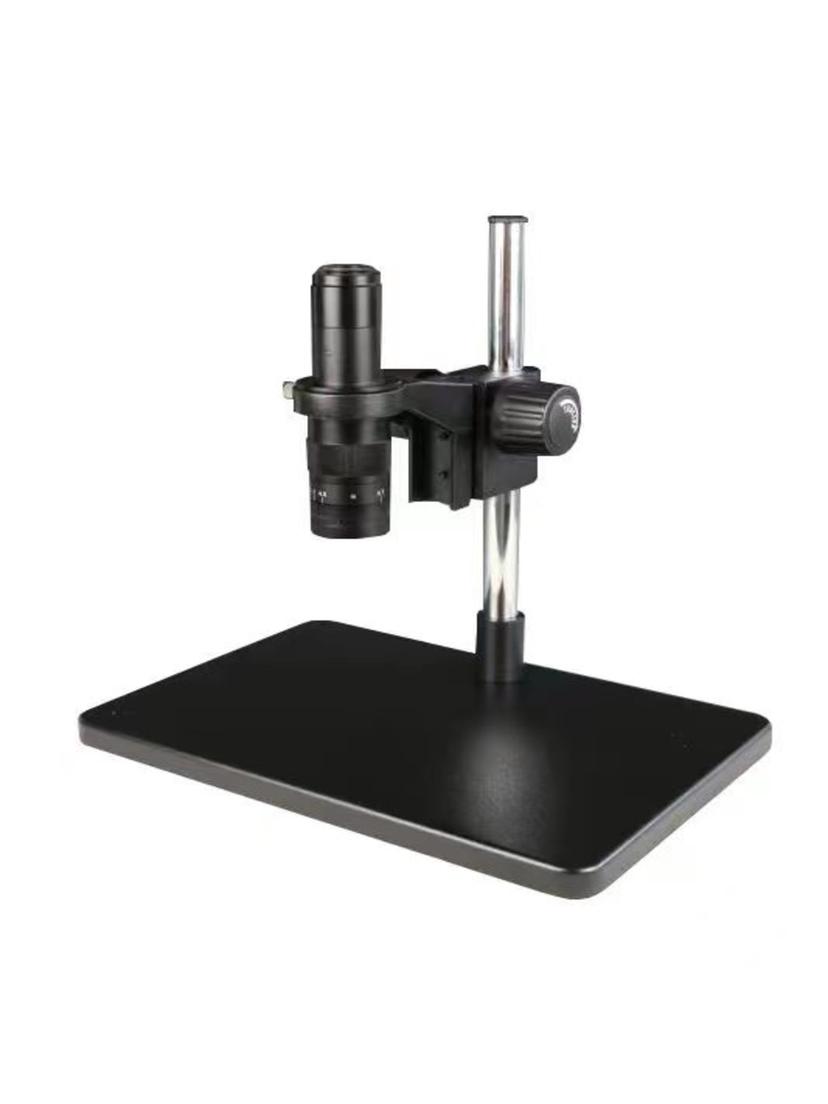
1. What Is an Infinity Optical System?
Infinity optical system is an advanced optical structure widely used in modern industrial microscopes.
Different from traditional finite optical systems, an infinity optical system uses an objective lens to produce parallel light rays, which are then focused into an image through a tube lens.
The space between the objective lens and tube lens provides flexibility for adding optical components, making the system more suitable for industrial applications requiring modular design and system integration.
2. Why Does Industrial Microscopy Need Infinity Optical Systems?
Industrial microscopes are no longer only used for visual observation.
In industries such as electronics, precision machining, semiconductor, and mold manufacturing, microscopes are required to perform inspection, measurement, image recording, and quality analysis.
For example, during connector inspection, manufacturers need to observe surface defects while checking dimensions such as pin spacing and position accuracy.
Therefore, an industrial microscope needs not only clear imaging but also stable performance and repeatable inspection results.
3. Advantages of Infinity Optical Systems in Industrial Microscopes
Modular Design
One of the main advantages of infinity optical systems is their excellent expandability.
Because the optical path between the objective lens and tube lens can accommodate additional components, manufacturers can integrate industrial cameras, coaxial illumination, filters, and other modules according to different inspection requirements.
This design makes infinity optical systems suitable for customized optical inspection equipment.
Better Integration with Machine Vision
Modern manufacturing increasingly uses automated inspection systems.
An industrial microscope often works together with cameras, motion stages, lighting systems, and measurement software.
Infinity optical systems provide stable imaging and easier integration with digital imaging devices, making them widely used in machine vision and automated inspection applications.
For example, in electronic component inspection, a microscope system can capture images automatically and analyze defects or dimensional differences through software.
Improved Image Stability
For industrial inspection, consistent imaging quality is more important than simply increasing magnification.
Infinity optical systems optimize the relationship between objective lenses and tube lenses, helping reduce optical distortion and improve image uniformity.
This stability is especially important for precision measurement, defect detection, and long-term production inspection.
4. Applications of Infinity Optical Systems
Infinity optical systems are widely used in:
Electronic Component Inspection
Used for inspecting connectors, PCB components, and semiconductor parts.
Precision Manufacturing
Used for checking machining quality, surface defects, and small structural features.
Material Analysis
Applied in metallurgical microscopes for observing material structures and processing conditions.
Automated Inspection Systems
Integrated with industrial cameras and software for automatic measurement and quality control.
5. Why Infinity Optical Systems Become the Standard Choice?
The development of industrial microscopes is closely related to automation and intelligent manufacturing.
Today’s inspection equipment combines optics, mechanics, electronics, and software into a complete measurement system.
Infinity optical systems provide the flexibility and compatibility required for these applications, allowing industrial microscopes to connect with cameras, automation platforms, and analysis software.
For this reason, infinity optical systems have become an important optical structure for modern industrial microscopes and precision inspection equipment.
🌐 Website: https://www.jatentech.com/products/microscope