





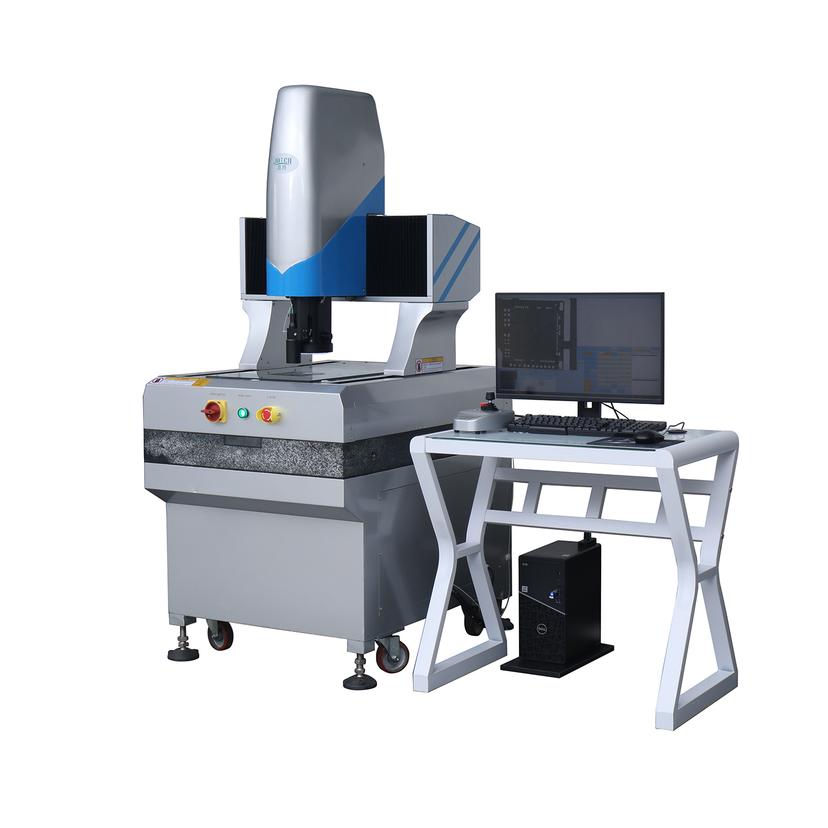
It is very common for video measuring machines to show variations in measurement results after being used in industrial environments for a period of time. In most cases, this is not caused by equipment failure, but by the gradual accumulation of multiple system-related factors during long-term operation.
To understand the importance of regular calibration, it is necessary to first understand how measurement errors are generated.
1. Environmental and Temperature Effects
Temperature variation is one of the primary factors affecting measurement stability.
The machine structure, workpiece materials, and reference standards all expand or contract with environmental changes. In high-precision measurement, even small variations can affect final dimensional results.
In real production environments, temperature differences at different times of the day may lead to inconsistent measurements of the same part. This is especially noticeable in long or high-precision components.
2. Long-Term Changes in the Mechanical Motion System
Video measuring machines rely on XYZ axis motion systems for positioning and measurement.
After long-term operation, the lubrication condition of guideways may gradually degrade, and dust contamination or slight wear may affect motion smoothness. Although the machine continues to operate normally, repeat positioning accuracy may gradually decline.
These changes do not occur suddenly; they accumulate over time and often appear as increased data dispersion or reduced repeatability during batch measurement.
3. Changes in Linear Encoder and Optical System
The linear encoder is responsible for feedback of the actual platform displacement and is a critical component affecting measurement accuracy.
If the encoder is affected by contamination, vibration, or slight installation shifts, cumulative errors may occur. In some cases, short-distance measurements remain accurate, while long-distance measurements gradually show increasing deviation. This is usually related to encoder condition or system compensation settings.
At the same time, the lens may also develop slight magnification changes over long-term use. Optical distortion is more noticeable at the edges of the field of view, which may lead to inconsistent results at different positions.
4. Light Source and External Interference
The condition of the lighting system is often overlooked in measurement stability.
Over time, the light source may experience brightness degradation or uneven illumination, resulting in reduced image contrast and affecting edge detection performance. This is particularly significant when measuring transparent parts, reflective surfaces, or precision metal components.
In addition, external vibration is another important factor. If the machine is installed near stamping machines or high-speed processing equipment, even if the vibration is not visible to the human eye, micro-vibrations can still affect high-magnification imaging stability, leading to measurement fluctuations.
5. Software Parameters and the Importance of Calibration
In addition to hardware factors, software settings and operating methods also affect measurement results. If measurement parameters are adjusted arbitrarily or different operators use different settings, inconsistent results may occur for the same workpiece.
Therefore, standardization of measurement parameters is essential in batch inspection.
Based on the above factors, regular calibration is not simply about measuring standard blocks. It is a comprehensive verification of the entire measurement system, including optical imaging stability, motion system accuracy, encoder feedback, and software consistency.
Its core purpose is to ensure that the equipment remains reliable and stable during long-term operation.
Conclusion
The measurement results of a video measuring machine are not fixed values, but dynamic outputs formed by the combined effects of optics, mechanics, environment, and software. As usage time increases, these factors gradually change, affecting measurement stability.
Therefore, the purpose of regular calibration is not to “adjust the machine,” but to continuously verify whether the system remains reliable. In precision manufacturing, what truly matters is not single measurement accuracy, but long-term data consistency and stability.