





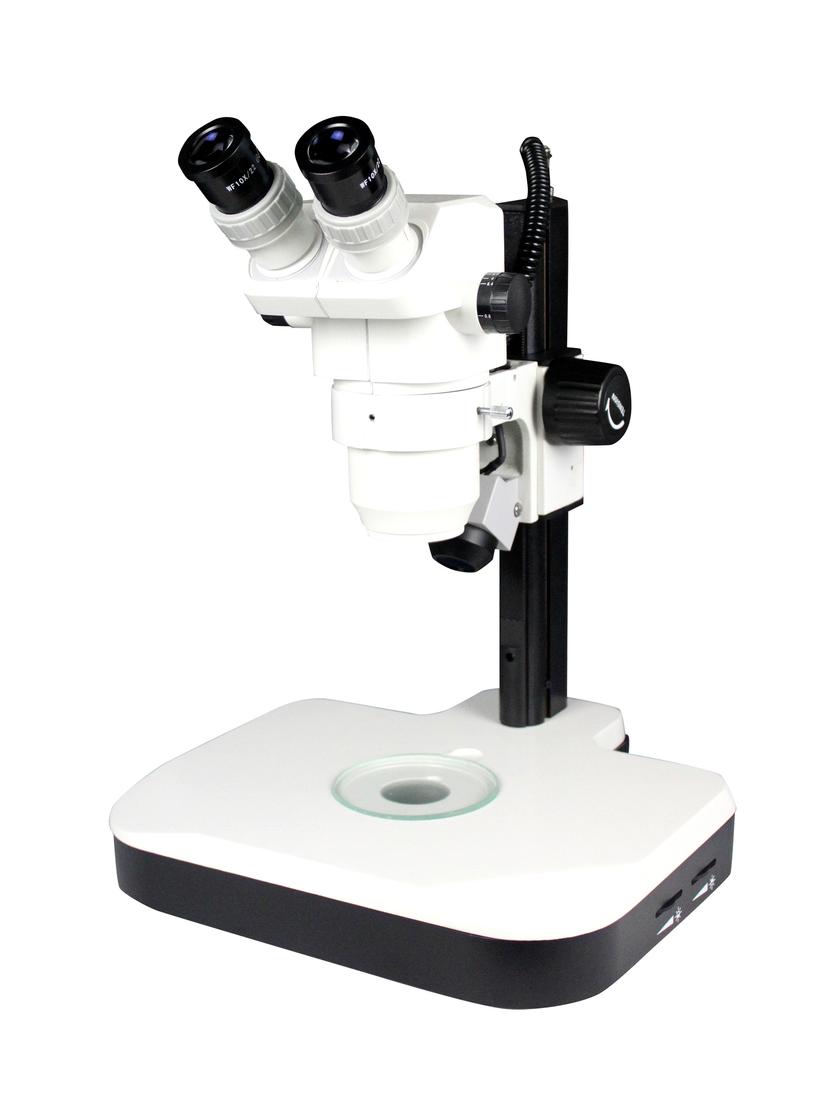
In industrial inspection, the optical system not only determines microscope imaging performance but also directly affects the equipment’s expandability and application flexibility.
With the development of industrial cameras, automatic measurement software, and intelligent inspection systems, microscopes have evolved from traditional observation tools into comprehensive inspection platforms integrating image acquisition, dimensional analysis, defect detection, and data management.
In this process, the infinity optical system has gradually become the mainstream structure of modern industrial microscopes due to its open optical design and excellent compatibility with various functional modules.
Compared with traditional finite optical systems, the advantages of an infinity optical system are not only reflected in image quality but also in its ability to integrate optical accessories, industrial cameras, and automation modules more efficiently.
1. What Is an Infinity Optical System?
An infinity optical system uses an infinity-corrected objective design.
In a traditional finite optical system, the objective lens directly forms an intermediate image. However, in an infinity microscope system, the objective lens outputs parallel light.
The parallel light area between the objective lens and the tube lens is called Infinity Space.
In an infinity optical system, the objective lens converts sample information into parallel light, and the tube lens then focuses the parallel light to form the final image.
This design creates an independent optical space between the objective lens and tube lens, allowing different functional components to be integrated according to application requirements.
Many high-performance industrial microscopes now use CCIS infinity optical systems, which optimize the matching between objectives and tube lenses to improve imaging consistency and system stability across different magnifications.
2. Difference Between Infinity Optical System and Finite Optical System
A finite optical system has a relatively fixed optical path.
Because the light from the objective lens is already involved in the imaging process, adding optical components into the light path may change the optical conditions, causing focus shift, magnification changes, or increased aberrations.
For example, when adding a beam splitter to a finite optical system, the optical parameters may need to be readjusted to maintain image quality.
An infinity optical system works differently.
Since the objective lens outputs parallel light, optical components installed in the Infinity Space mainly affect light characteristics without significantly changing the final imaging position.
This improves system stability and allows industrial microscopes to be expanded according to different inspection requirements.
For industrial equipment that needs long-term operation, system stability and upgrade capability are often more important than improving only a single optical parameter.
3. Why Can Filters Be Added to an Infinity Optical System?
Filters are common optical accessories used in industrial microscopes. They are mainly used to adjust wavelength ranges, improve image contrast, and control light intensity.
In an infinity optical system, the parallel light condition allows filters to be added without affecting the original imaging relationship.
For example:
During metal surface inspection, tiny scratches and cracks can be difficult to identify due to strong reflections. By selecting suitable wavelength filters, the contrast between defects and background can be improved.
During electronic component inspection, different materials have different reflection characteristics. Optical filters can reduce unwanted reflections and improve the recognition of circuit structures.
In fluorescence observation and material analysis, different filter combinations are also required to extract specific wavelength signals.
Besides filters, polarization components and ND filters are also widely used in industrial microscopes.
Polarizers can reduce glare from highly reflective materials such as glass and metal, while ND filters can adjust the amount of light entering the camera to prevent image overexposure.
4. How Does a Beam Splitter Improve Industrial Inspection Efficiency?
Modern industrial inspection is gradually moving from manual observation to digital image analysis.
A complete industrial microscope system usually needs to support both visual observation and digital image acquisition.
A beam splitter divides the optical path into two channels:
One channel goes to the eyepiece for real-time observation;
The other channel goes to the industrial camera for image recording and software analysis.
For example, during precision component inspection, operators can quickly locate inspection areas through the eyepiece, while the industrial camera captures high-resolution images and measurement software automatically analyzes dimensions, profiles, and defects.
This approach improves inspection efficiency and also enables quality traceability.
In automated inspection systems, microscopes can be combined with motorized stages to perform continuous inspection at multiple positions, improving production line inspection capability.
5. How Camera Modularity Improves Microscope Upgrade Capability
With the rapid development of industrial camera technology, different inspection applications require different imaging solutions.
General appearance inspection requires stable and reliable cameras;
Precision measurement requires high-resolution and low-distortion imaging;
High-speed inspection requires faster image acquisition performance.
Infinity optical systems support modular camera integration, allowing industrial cameras to be connected as independent imaging modules.
For example, the same industrial microscope platform can be equipped with different cameras according to inspection requirements:
Standard CMOS cameras for routine inspection;
High-resolution cameras for microstructure analysis;
High-speed cameras for dynamic process observation.
When inspection requirements increase in the future, users only need to upgrade the camera or software system instead of redesigning the entire optical structure.
6. Applications of Infinity Optical Systems in Industrial Inspection
Infinity microscopes are widely used in semiconductor inspection, electronics manufacturing, precision machining, and material analysis.
In semiconductor inspection, wafers, chips, and microelectronic structures require high magnification and high-resolution observation. At the same time, industrial cameras and image processing algorithms are needed for defect analysis. Infinity optical systems allow flexible integration of different objectives and digital imaging modules.
In precision manufacturing, such as mold inspection, mechanical parts, and machined components, infinity microscopes can be combined with measurement software to achieve non-contact dimensional inspection.
In electronics manufacturing, products such as PCBs and connectors require rapid identification of surface defects. Infinity optical systems support various illumination methods and imaging solutions to meet complex inspection requirements.
7. The Real Value of Infinity Optical Systems
The importance of an infinity optical system is not only improving image clarity but also changing the development direction of industrial microscopes.
Through standardized optical architecture, objectives, tube lenses, filters, beam splitters, industrial cameras, and automation systems can be integrated into a complete inspection solution.
For industrial users, an excellent microscope system should not only meet current inspection requirements but also provide long-term upgrade and expansion capability.
This is why infinity optical systems have become an important development direction for modern industrial microscopes and are widely used in precision manufacturing and intelligent inspection applications.
For more information or inquiries:
🌐 Website: https://www.jatentech.com/products/microscope