





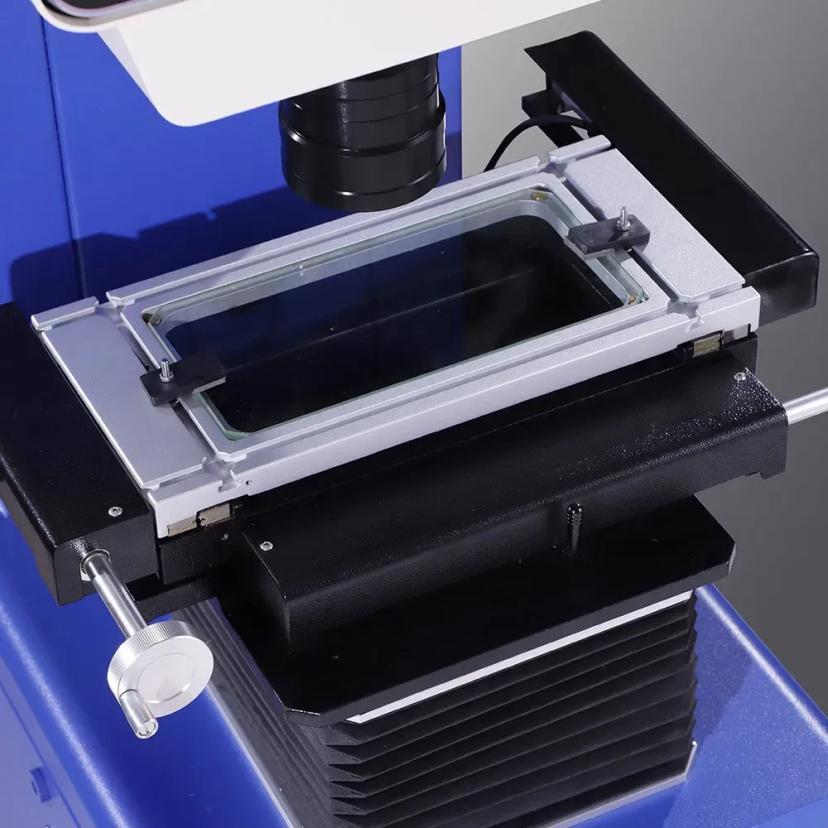
In practical inspection work, it is common to see measurement differences when the same part is checked by different operators. This issue is especially noticeable when using an optical comparator.
In most cases, the cause is not machine accuracy, but how the edge is interpreted during measurement.
1. Why Optical Comparator Measurement Depends on Human Judgment
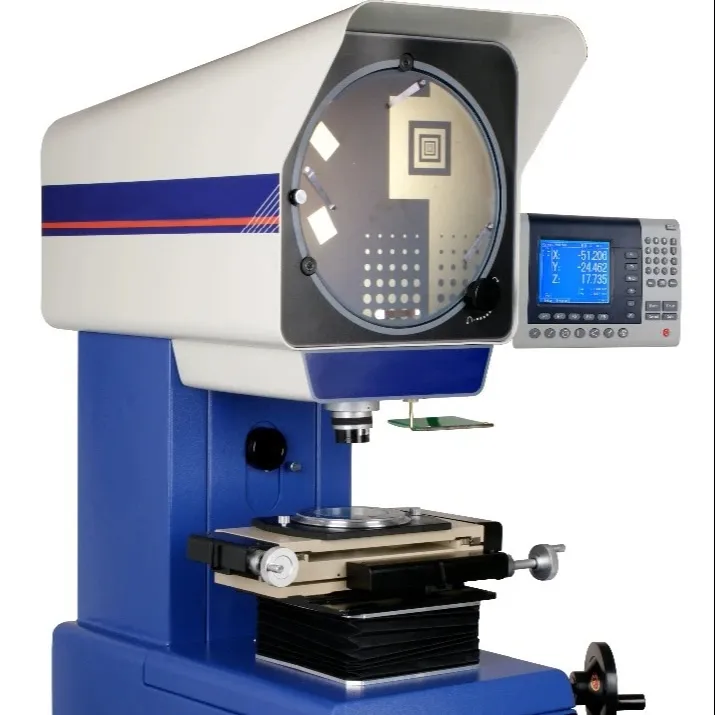
An optical comparator magnifies and projects the part profile onto a screen for inspection. The system provides a clear image, but the exact measurement position still depends on the operator.
In simple terms:
The machine displays the image
The operator decides where the edge is
This makes the measurement process partly subjective and can lead to differences between operators.
2. Edges Are Not Perfect Lines
In optical imaging, an edge is not a sharp geometric line. Instead, it is a transition zone from bright to dark.
Key points:
Edges appear as a gray transition area
Width can range from a few microns to tens of microns
Clarity varies depending on contrast
During measurement, the operator is choosing a reference point:
Brighter side
Darker side
Middle point
Without a unified standard, different choices lead to inconsistent results.
3. Optical Limitations Affect Edge Clarity
All optical systems are limited by physics:
Diffraction
Lens resolution
Depth of field
These factors can cause edge blur, especially in:
High magnification
Small feature measurement
Inconsistent focusing
For example, measuring small features at high magnification may show expanded or unclear edges, making consistent positioning harder.
4. Lighting Conditions Directly Influence Measurement
Lighting is a critical factor for edge interpretation.
Common effects:
Strong light may cause edges to expand
Weak light may shrink edges
Changing angles can distort the profile or create shadows
Inconsistent lighting can cause different results even for the same part. Maintaining stable lighting is essential for repeatable measurement.
5. Material Differences Affect Edge Detection
Material properties also influence edge clarity:
Reflective metals may create bright edges or glare
Plastic or semi-transparent materials may produce fuzzy boundaries
Dark materials may have low contrast
This increases uncertainty and adds difficulty to manual edge judgment.
6. Higher Magnification Does Not Always Improve Accuracy
It is often assumed that higher magnification leads to better accuracy. However:
Gray transition zones become more visible
Edge blur is amplified
Judgment becomes more difficult
Selecting appropriate magnification is better than blindly increasing it.
7. How to Reduce Human Error
To improve consistency, common practices include:
Standardize edge selection
Define a consistent rule (e.g., bright edge or mid-point) for all operators.
Keep lighting consistent
Fix intensity, angle, and type to reduce variability.
Standardize focusing
Use a consistent method, e.g., focus on the sharpest edge contrast.
Use reference parts for verification
Regular checks with standard parts help identify differences between operators.
Introduce automated measurement systems
Video measuring machines can detect edges using image processing algorithms, reducing subjective interpretation.
8. Choosing the Right Measurement Method
Optical comparators are still useful for quick inspection and simple profile checks. However, when repeatability is critical, human interpretation often becomes the limiting factor.
Video measuring machines apply consistent edge detection algorithms, providing more stable and repeatable results under the same conditions.
9. Conclusion
Measurement differences in optical comparator use are often caused by uncertainty in edge interpretation rather than machine accuracy.
Since edges do not have a single fixed position in optical imaging, human error cannot be completely eliminated. However, standardizing procedures, controlling optical conditions, and adopting automated systems when needed can significantly improve measurement consistency.