





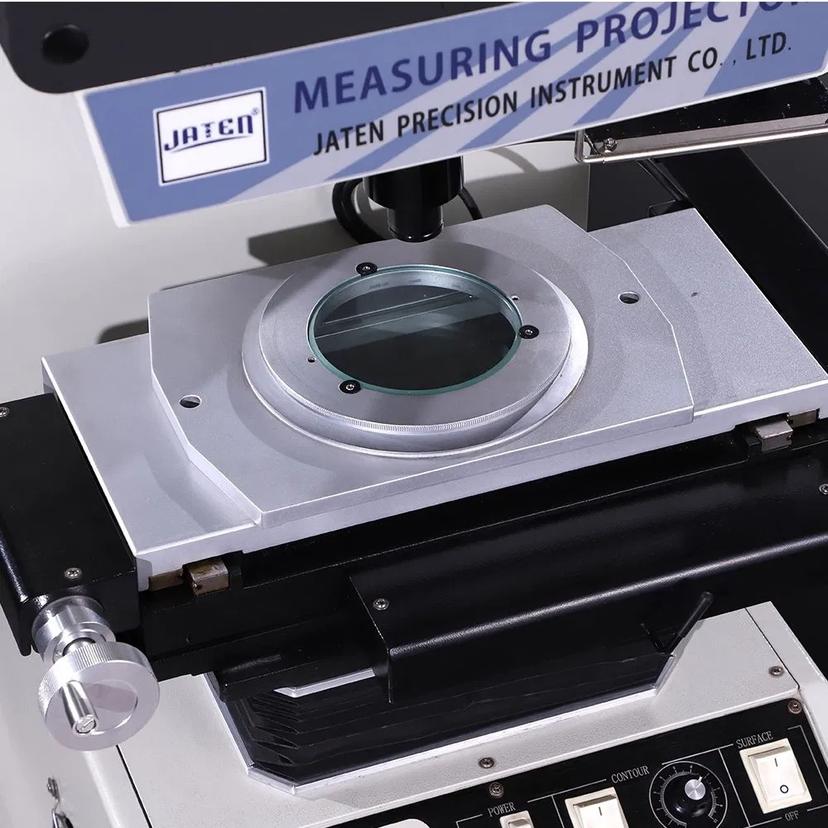
1. The Role of Data Processing Systems in Measurement
In modern contour measuring equipment, the data processing system has gradually evolved from an auxiliary function into a core component. Its role is not limited to data reading, but also includes the digital conversion of optical contour information.
Taking the DP300 multifunctional data processing system as an example, its main functions include point, line, angle, and distance measurement, while also supporting multi-point sampling, coordinate rotation, and data output.
With these capabilities, the profile projector has evolved from a traditional visual inspection device into a digital inspection system.
2. Multi-point Sampling and Curve Fitting Mechanism
In curved-part inspection, single-point measurement cannot accurately represent the actual contour condition. Therefore, multi-point sampling has become one of the key measurement methods.
The system collects multiple contour points and reconstructs the curve shape through mathematical fitting algorithms, reducing the influence of local errors on overall results and improving measurement stability.
In the inspection of arcs, cams, and irregular contours, multi-point sampling significantly improves consistency and allows measurements to better reflect the actual machining condition.
This method is especially important for stamped parts and mold components, where minor surface fluctuations are common during manufacturing.
3. Coordinate Rotation Logic and Engineering Significance
During complex part inspection, workpieces are not always positioned in a perfectly horizontal or vertical orientation.
If the measurement process relies entirely on mechanical alignment, it may increase manual adjustment errors and reduce inspection efficiency.
The essence of coordinate rotation is to establish a new measurement reference coordinate system, allowing mathematical correction of workpiece orientation and minimizing positioning errors.
This function is highly valuable for inclined parts, irregular structures, and batch inspection applications.
4. System Error Control and Stability Analysis
Measurement system errors generally originate from three main sources:
Optical distortion errors
Mechanical movement errors
Data sampling errors
Optical errors can be corrected through lens calibration, while mechanical errors depend on the structural precision of the equipment. Sampling errors are reduced through multi-point averaging methods.
The data processing system further improves overall measurement stability through software compensation mechanisms, making inspection results more consistent.
5. Industrial Data Management and Traceability
In mass production environments, measurement data is used not only for immediate inspection decisions but also for quality traceability and process analysis.
Through the RS-232 data output function, measurement results can be directly transferred to computers or quality management systems for data storage and batch management.
When quality issues occur, historical measurement data can help identify the source of the problem more efficiently, improving process control capability.
6. Conclusion
The data processing system of a horizontal profile projector has transformed traditional optical measuring equipment from manual interpretation into digital inspection technology.
Its core advantages include:
Improving curve measurement stability
Reducing human measurement errors
Enabling traceable inspection data
In precision manufacturing and mass production environments, these systems have become an important part of improving inspection efficiency and quality control capability.