





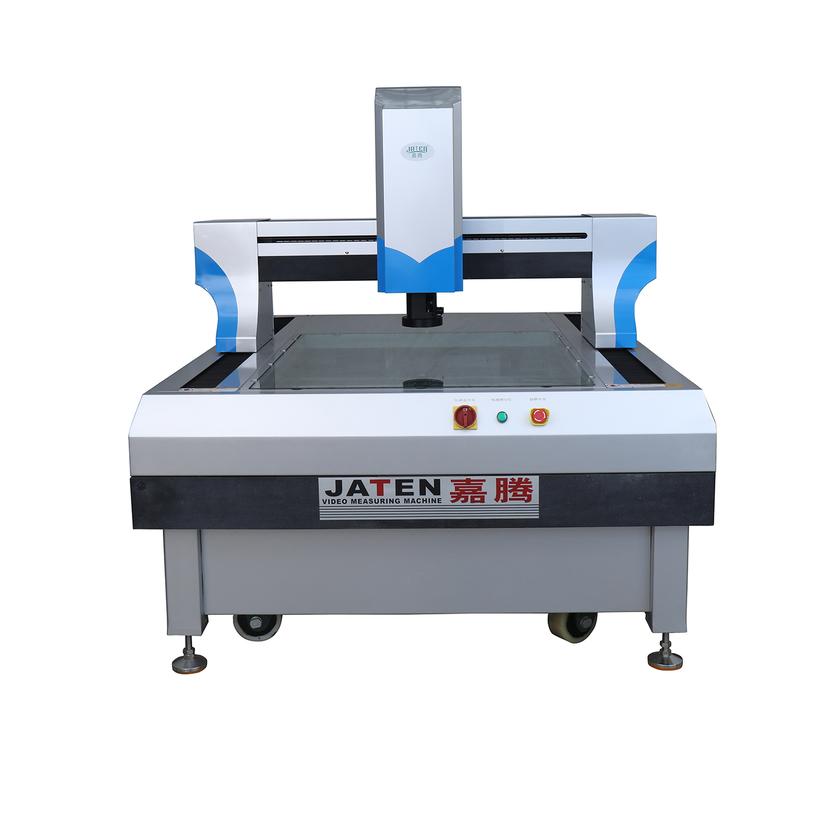
In practical industrial applications of large-travel vision measuring systems, a common misunderstanding is that parameters such as magnification, camera resolution, or stated accuracy determine performance. In reality, system stability during long-term and high-speed operation is the key factor.
A vision measuring machine is not simply an optical magnification device, but a coordinate reconstruction system that integrates optics, motion control, mechanics, and software algorithms.
1. Measurement Principle: Image and Coordinate Fusion
A vision measurement system consists of four core components:
Optical lens for image formation
CCD/CMOS camera for image acquisition
Illumination system for edge definition
Software for feature extraction and calculation
However, the real essence of measurement is not what is seen, but how image coordinates are converted into mechanical coordinates.
For example, in PCB inspection, the system captures pads and holes through optical imaging. The software extracts edge points from grayscale changes, while the X/Y axis linear encoders provide real motion feedback. All data is unified into a coordinate system to calculate dimensions such as hole spacing and line width.
✔ Conclusion:
Vision measurement is the fusion of pixel coordinates and motion coordinates, not simple optical scaling.
2. Optical System: Defines the Measurement Lower Limit
The optical system does not only magnify the object; it determines the quality of imaging.
Key factors include:
Lens distortion control
Imaging consistency
Edge resolution capability
In large-travel systems, lens distortion can cause systematic coordinate deviation, even if local precision is high.
The camera system (CCD/CMOS) affects:
Grayscale stability
Noise level
Edge sharpness
In reflective materials such as copper foil or glass, unstable grayscale leads to edge drifting and measurement deviation.
Engineering role of illumination
Lighting is not simply for illumination, but for defining edges.
Typical lighting types:
Coaxial light: suppresses reflection
Ring light: provides uniform surface illumination
Contour light: enhances edge profile
✔ Conclusion: Illumination determines edge quality, and edge quality defines measurement stability.
3. Motion and Structure System: Defines Accuracy Upper Limit
In large-travel systems, motion control is more critical than optics.
Bridge-type gantry structure is widely used to ensure geometric stability during long-axis movement. Compared with cantilever structures, gantry systems reduce deflection and vibration under high-speed motion.
Dual-Closed-Loop Control System
The system uses servo motors combined with dual feedback loops:
Motor encoder feedback (theoretical motion)
Linear encoder / optical scale feedback (actual position)
In traditional semi-closed-loop systems, motor movement does not always equal actual stage displacement due to mechanical backlash and inertia.
Dual-closed-loop systems continuously correct these deviations, ensuring accurate positioning even at high speed.
✔ Core concept: actual position overrides theoretical position.
Mechanical structure considerations
Linear guide rails ensure straight-line motion
Ball screw system ensures transmission accuracy
Granite base reduces thermal deformation and vibration
Granite provides excellent thermal stability, making it ideal for long-term measurement consistency.
✔ Conclusion: Mechanical structure defines long-term stability.
4. Automation and Applications: Stability Defines Productivity
Modern large-travel vision measuring machines are no longer standalone measurement tools but automated inspection systems.
Key automation features include:
Z-axis autofocus based on image sharpness
Automatic zoom lens calibration
Fully automatic path measurement
Typical applications include:
PCB boards, copper-clad laminates, flat glass, LCD modules, stamping dies, and insulating materials.
These industries share common characteristics:
Large dimensions
Dense features
High measurement volume
Strict repeatability requirements
For example, in PCB inspection, small motion errors can accumulate during batch measurement, affecting overall consistency evaluation.
✔ Conclusion: Industrial measurement is not about single-point accuracy, but batch consistency.
Conclusion: System Stability Defines Equipment Level
From an engineering perspective, a large-travel automatic vision measuring machine is not a single device but a system integration of optics, mechanics, motion control, and software.
Optics define visibility
Motion defines positioning accuracy
Control defines correction capability
Software defines computation results
However, the real determinant of equipment class is long-term measurement consistency under real production conditions.
The essence of vision measurement is not how precise it measures once, but how consistently it performs over time.