





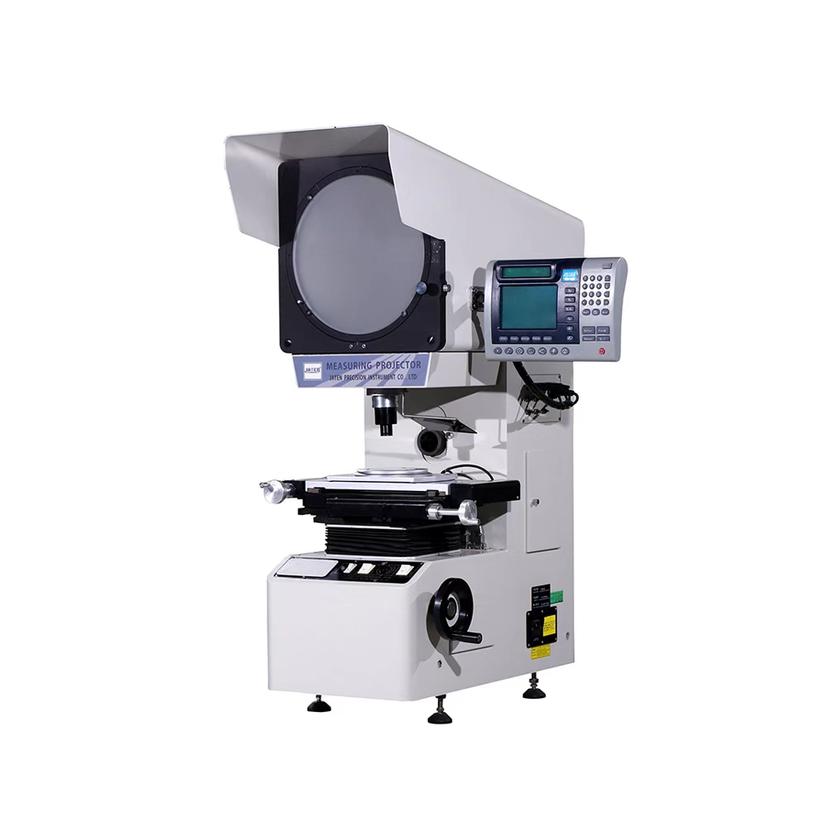
1. What is Backlight Measurement
Backlight, also known as transmitted light or contour lighting, is one of the most commonly used illumination methods in profile projectors.
The light source is installed beneath the glass stage, projecting light vertically upward. When a workpiece is placed on the stage, areas that block light appear dark, while areas that allow light to pass appear bright. The boundary between light and dark is identified as the contour edge.
In essence, this method measures the geometry of a part through its projected silhouette rather than direct physical contact.
2. Advantages of Backlight Measurement
One of the key advantages of backlight measurement is that it does not depend on the surface condition of the workpiece.
In real production environments, surfaces may vary:
Highly reflective (mirror-like)
Light-absorbing (black materials)
Uneven due to roughness
These factors can significantly affect reflected light measurement but have minimal impact on backlight. This is because backlight only depends on whether light passes through or is blocked.
For opaque parts such as stamped metal components or machined parts, backlight provides stable and repeatable measurement results.
3. Core Assumption and Practical Deviation
Backlight measurement is based on a fundamental assumption:
The light-dark boundary equals the true geometric edge.
While this holds under ideal conditions, real-world parts rarely have perfect edges. Combined with optical effects, the detected boundary may deviate from the actual edge.
Understanding this deviation is critical for improving measurement accuracy.
4. Formation of Edge Transition Zone
In theory, a sharp edge should produce a clear boundary. However, in practice, edges often include:
Fillets (radius edges)
Chamfers
Burrs
When light passes through these features, it undergoes diffraction and refraction, creating a gradual grayscale transition rather than a sharp boundary. This area is known as the edge transition zone.
5. Impact of Transition Zone on Accuracy
Measurement systems typically detect edges at the point of maximum grayscale change. However, this point is not fixed and varies with conditions:
Larger edge radius → wider transition zone
Stronger illumination → edge appears outward
Lower illumination → edge shifts inward
As a result, the same part may produce different measurement values under different lighting settings.
This effect is especially noticeable for parts with rounded edges or chamfers.
6. Reducing Edge Detection Errors
To minimize errors caused by transition zones:
Keep lighting conditions consistent
Optimize brightness to avoid overexposure or low contrast
Use reference parts or calibration when high precision is required
Consistency in setup is essential for reliable measurement results.
Conclusion
Backlight measurement is widely used due to its simplicity and stability. However, its accuracy depends heavily on how edges are formed and detected.
By understanding the transition zone and its influencing factors, users can significantly improve measurement consistency and reliability.