





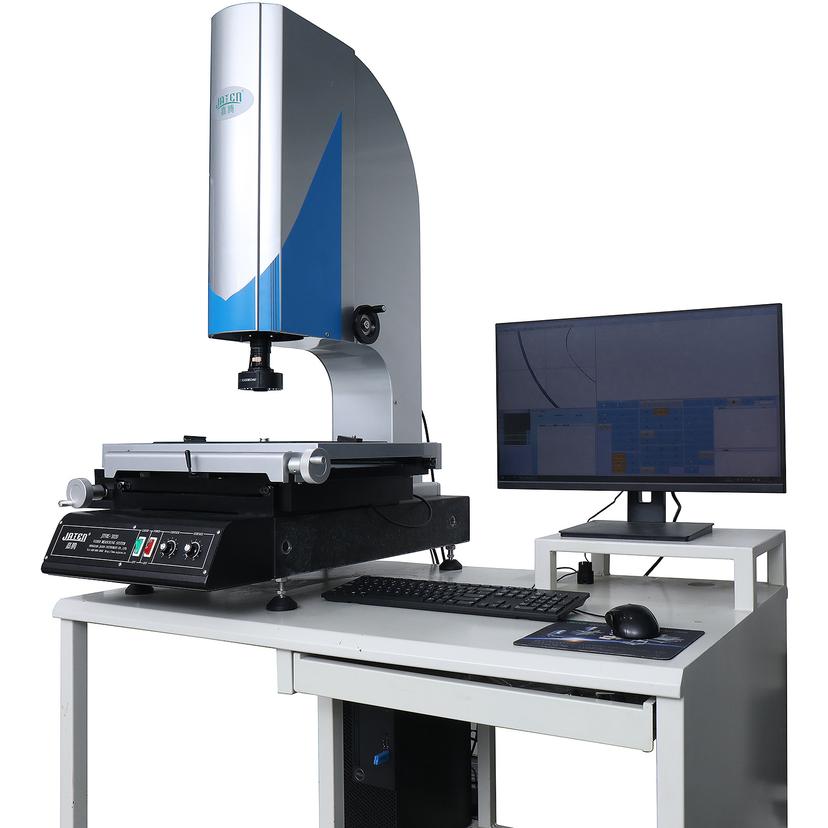
1. The Nature of Image Measurement: Images Are Not Physical Dimensions
In a Vision Measuring Machine (VMM), the camera does not capture real-world dimensions. Instead, it acquires a two-dimensional image made up of pixels. Each pixel only represents light intensity or color information and does not contain any physical unit such as millimeters or microns.
Therefore, the core function of an optical measurement system is not to “read dimensions from an image,” but to convert image-based data into real spatial measurements. This transformation forms the foundation of all industrial dimensional inspection.
2. Basic Workflow of Vision Measurement Systems
A typical Vision Measuring Machine operates through three main steps:
First is image acquisition, where an industrial camera and lighting system capture a clear image of the part.
Second is feature detection, where the system extracts edges, contours, or geometric features from the image.
Third is dimensional conversion, where pixel coordinates are mapped into real-world measurements.
These steps are highly interdependent. Image quality affects edge detection stability, and feature accuracy directly influences final measurement results in 2D vision measurement systems.
3. Optical System Influence on Measurement Accuracy
In an optical measurement system, lighting plays a critical role in measurement accuracy.
Backlight illumination is commonly used for 2D contour measurement because it produces high-contrast edges. Ring light is suitable for surface inspection but may cause edge distortion on reflective materials. Coaxial lighting works well for transparent or shiny surfaces but requires careful adjustment.
If the optical condition is unstable, edge detection results may shift, directly affecting final industrial dimensional inspection accuracy.
4. Edge Detection: Why Boundaries Are Not Simple Lines
In real images, object boundaries are not sharp geometric lines. Instead, they appear as grayscale transition regions.
Because of this, a Vision Measuring Machine does not rely on simple black-and-white thresholds. Instead, it analyzes grayscale gradients to locate the most stable boundary position.
This approach improves measurement stability and reduces variations caused by lighting changes, making 2D vision measurement more reliable in industrial applications.
5. Converting Pixels to Real Dimensions: The Role of Calibration
To convert pixel data into real-world measurements, a calibration process is required.
A calibration plate with known distances is used to establish a relationship between image coordinates and real physical coordinates.
This can be understood as building a “digital ruler” inside the system, which is then used for all subsequent measurements.
In high-precision VMM systems, this mapping also compensates for lens distortion and perspective errors, improving overall measurement consistency.
6. Key Factors Affecting Measurement Stability
Even after calibration, measurement results may still vary due to several factors:
Temperature changes causing slight mechanical deformation
Long-term mechanical wear of motion systems
Changes in lens or lighting without recalibration
Measurement position differences affecting optical response
These factors can influence the relationship between pixel data and real-world dimensions.
7. Application Example: Electronic Component Hole Measurement
In a typical industrial case such as hole diameter measurement, the system first uses backlight illumination to generate a clear contour.
Then, edge positions are extracted from the image, and pixel coordinates are converted into real-world values. Finally, the system calculates the hole diameter.
If lighting or calibration conditions change during the process, the final result may vary even if the procedure remains the same.
This demonstrates that measurement reliability depends on the stability of the entire system, not a single hardware component.
8. Conclusion: VMM Is a Spatial Mapping System
The core principle of a Vision Measuring Machine is not image recognition alone, but the transformation of 2D pixel data into real spatial dimensions.
Pixels are only the starting point. Measurement accuracy depends on three key elements:
Optical imaging system
Edge detection method
Calibration model
Only when these components work together stably can a VMM system deliver reliable and repeatable results for industrial dimensional inspection.