





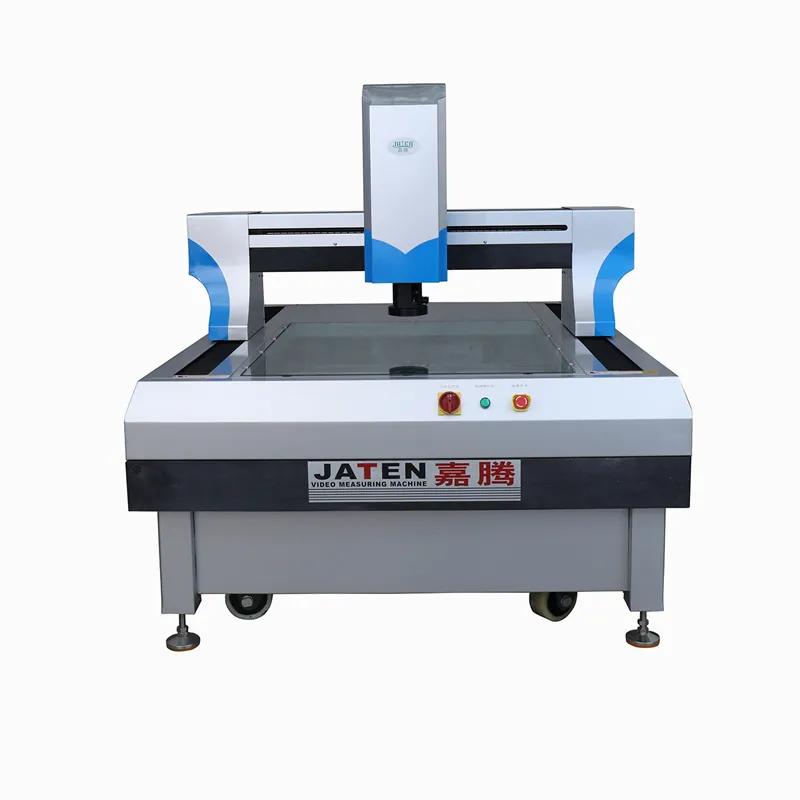
In the field of precision dimensional inspection, a Video Measuring Machine (VMM), as a typical non-contact optical measuring device, relies not only on its optical system and measurement software, but also heavily on the long-term stability of its mechanical structure. In practical applications, even when Video Measuring Machines share identical optical configurations and measurement principles, noticeable differences in measurement consistency and repeatability can still appear after years of continuous use. Such differences are rarely caused by short-term calibration issues, but rather by the cumulative effects of mechanical structural behavior over time.
Among various structural designs, the gantry structure (Gantry Type) has been widely adopted in medium- and large-size Video Measuring Machines and industrial optical measuring equipment. Its advantages are not reflected in a single specification, but in the controllability of error evolution and the stability of system performance during long-term operation.
Symmetrical Load Distribution and Measurement Consistency
A defining characteristic of gantry-type Video Measuring Machines is the symmetrical arrangement of the motion system on both sides of the worktable. X-axis guideways, drive systems, and load-bearing components are distributed on the left and right sides, allowing operational loads to be balanced within the structure. Under this configuration, structural deformation tends to appear as a uniform and slight global deflection rather than localized twisting or irregular deformation commonly seen in single-sided support designs.
From a measurement perspective, global micro-deflection produces continuous and predictable geometric changes, with limited impact on measurement repeatability. In contrast, asymmetric torsion introduces angular errors that alter the relative relationship between the optical axis and the measurement plane. Such errors are often difficult to detect during short-term testing, but over extended periods of use, they may manifest as reduced consistency across different measurement areas. Symmetrical load distribution effectively slows the accumulation of these irreversible errors.
Torsional Rigidity Over Bending Rigidity
In the mechanical design of a Video Measuring Machine, bending rigidity is often more intuitively considered. However, in actual measurement processes, torsional loads tend to have a more direct impact on measurement results. During coordinated X–Y axis movements, even minimal torsional deformation can cause angular deviation of the measurement coordinate system, affecting edge detection accuracy and dimensional calculation stability.
The gantry structure forms a relatively closed mechanical loop through its crossbeam and dual columns, distributing torsional loads across multiple load paths. This torsional resistance is particularly important for large-travel Video Measuring Machines. As the measurement range increases, structures with insufficient torsional rigidity are more likely to exhibit position-dependent measurement errors, whereas gantry structures are better suited to maintaining geometric consistency across the entire measuring range.
Center of Gravity Distribution and Wear Characteristics
In gantry-type Video Measuring Machines, the measuring head, lens, and camera are typically positioned near the center of the crossbeam, resulting in minimal variation in the system’s center of gravity during motion. While this configuration does not directly enhance a specific accuracy parameter, it has a significant long-term effect on the wear characteristics of guideway systems and linear drive components.
With a stable center of gravity, loads applied to guideways are more evenly distributed, and fluctuations in drive system loads are reduced. As a result, wear tends to be uniform, slowing the growth of geometric errors over time. This makes it easier for the Video Measuring Machine to maintain measurement repeatability through periodic calibration. Conversely, structures with greater center-of-gravity shifts are more prone to localized wear, increasing maintenance complexity and calibration difficulty as service life extends.
Predictability of Thermal Deformation
In real-world operating environments, Video Measuring Machines and other optical measuring equipment are inevitably affected by ambient temperature variations and internal heat generation. The critical issue is not whether thermal deformation occurs, but whether the deformation follows a predictable pattern.
Due to its symmetrical design, a gantry structure typically exhibits uniform linear expansion or contraction under thermal influence, resulting in consistent effects on the measurement coordinate system. This predictability provides a solid basis for structural allowances and software-based compensation. In industrial inspection environments, such characteristics are especially important. In contrast, asymmetrical structures are more likely to experience localized warping or angular changes when exposed to thermal fluctuations, introducing additional uncertainty into long-term measurement stability.
Engineering Significance of Structural Selection
From an engineering standpoint, the mechanical structure of a Video Measuring Machine is not designed solely for high rigidity or high speed. Instead, it must balance structural stability, error evolution behavior, and long-term maintainability. The value of the gantry structure does not lie in short-term test data, but in the stable behavior of the measurement system over time.
For applications requiring long-term continuous operation and high measurement consistency, optical measuring equipment with symmetrical structures and strong torsional rigidity—such as gantry-type Video Measuring Machines—offers a clear advantage in maintaining stable measurement performance. This is a fundamental reason why gantry structures continue to be widely adopted in precision measurement and quality inspection applications.
https://www.jatentech.com/products/video-measuring-machine
https://www.jatentech.com/product/video-measuring-machine-jtdmv