





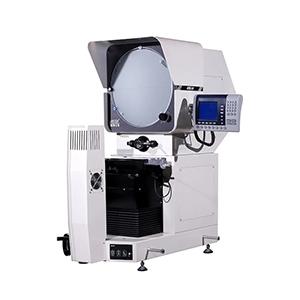
In precision manufacturing, profile projectors are widely used for dimensional inspection and contour observation. Compared to contact measurement devices, they are intuitive and flexible. However, users often notice that repeated measurements of the same workpiece can vary, and results may differ between operators.
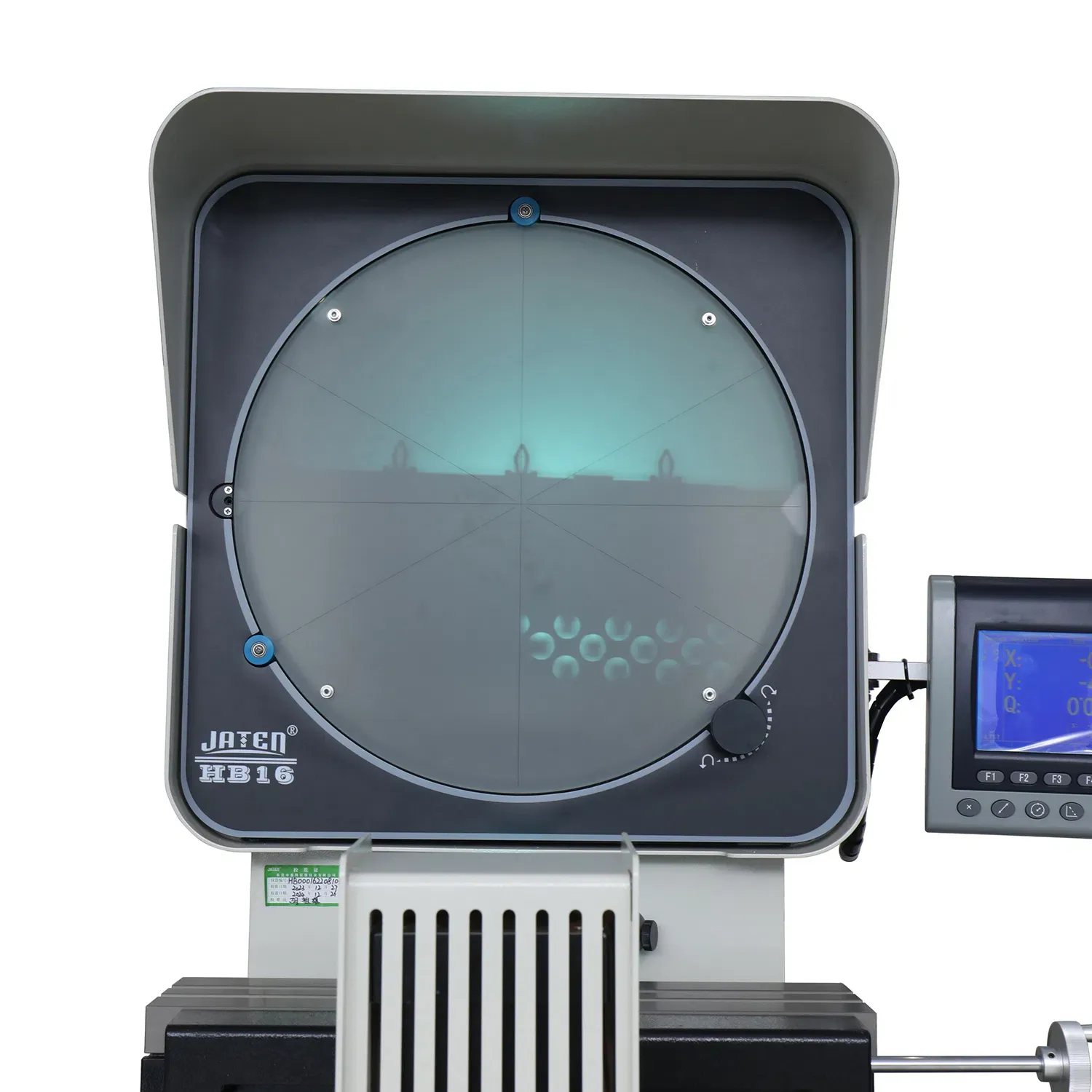
Understanding this requires looking at the operating principle. A profile projector is not fully automated; it relies on optical imaging and human interpretation. Therefore, measurement results are influenced by multiple factors, not just the device itself. Typically, these can be grouped into three categories: system errors, random errors, and human errors.
1. System Errors: Stable Deviations from the Device Itself
System errors originate from the equipment’s design and structure, and they tend to remain consistent over time.
Optical components are the primary source. Lens characteristics mean that magnification is not uniform across the field of view, especially in large-screen projectors. Measurements near the edges can differ slightly from those at the center.
Alignment of the optical axis is also important. If the light source, lens, and screen are not perfectly aligned, geometric distortions may occur, affecting dimensional accuracy.
Mechanical factors, such as the straightness of guide rails or gaps in drive screws, can also introduce position errors. This effect is more pronounced during long-travel or repeated measurements.
System errors do not fluctuate randomly but must be controlled through regular calibration.
2. Random Errors: Environmental Influences
Random errors arise from external conditions and the state of the workpiece, making measurement results less predictable.
Temperature changes are a common factor. Workpieces may expand or contract slightly with temperature, and prolonged device operation can cause thermal drift in the optical system, affecting image stability.
Vibration can impact results as well. Nearby machinery may transmit small vibrations to the projector, causing minor image shake and unclear contours.
Lighting stability is also critical. Variations in light intensity can reduce edge contrast, making boundary determination more difficult.
Workpiece conditions, such as burrs, oil, or reflective surfaces, can further affect edge clarity, leading to inconsistent measurements.
Random errors cannot be fully eliminated, but they can be minimized by controlling environmental conditions and ensuring consistent workpiece preparation.
3. Human Errors: Operator-Dependent Factors
Human factors often have the most direct impact on measurement consistency.
Focus adjustment is crucial. If the focal point is not properly set, the contour edges become blurred, affecting dimensional judgment.
Edge interpretation varies between operators. Since measurement relies on visual observation, different operators may select slightly different boundary points, resulting in inconsistent readings.
Workpiece placement and alignment also matter. Improper positioning or unstable fixation can cause dimensional or angular deviations.
Operator habits, such as whether to perform repeated measurements or zero calibration, can further influence results.
Human errors can be mitigated through standardized procedures and training but are difficult to eliminate entirely.
Conclusion
Profile projector measurement results are the combined outcome of optical, mechanical, and human factors. System errors determine the device’s baseline accuracy, random errors affect measurement stability, and human errors influence consistency.
To improve reliability, it is essential to maintain proper device calibration, control environmental conditions, and implement standardized operation procedures. By understanding the sources of errors, operators can achieve more accurate and repeatable measurements for precise inspection requirements.