





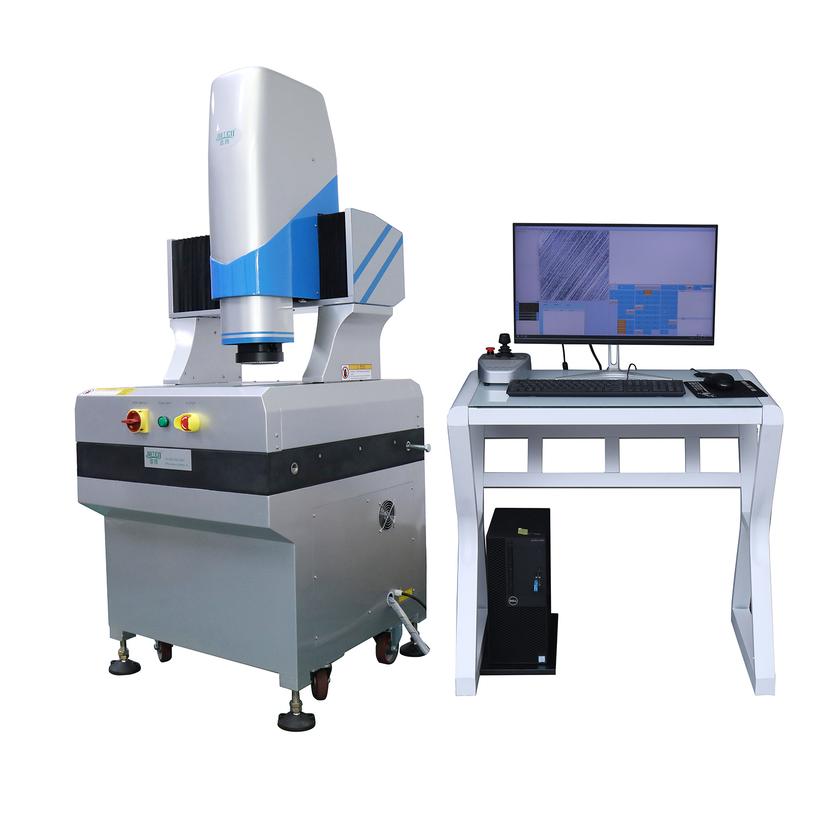
In modern precision measurement systems such as Video Measuring Machines (VMM), optical measuring systems, and high-accuracy dimensional inspection equipment, the X/Y axis feedback system plays a critical role in determining measurement accuracy and repeatability.
The two most commonly used position feedback solutions in industry are the glass optical scale and the metal magnetic scale. Each has different working principles and is designed for different application environments.
1 Working Principle of Glass Optical Scale
A glass optical scale consists of a low thermal expansion glass substrate, precision gratings, and an optical reading head. Its working principle is based on the Moiré fringe effect and photoelectric conversion.
When the reading head emits light onto the grating, two periodic patterns overlap and generate alternating light and dark signals. As the stage moves, these signals are converted into displacement data by the sensor.
In VMM and precision measurement systems, glass scales provide:
High repeat positioning accuracy suitable for micron-level measurement
Strong interpolation capability for higher resolution
Non-contact structure for long-term stability
Therefore, glass optical scales are widely used in metrology-grade VMM systems, inspection platforms, and laboratory measurement equipment.
However, they require a clean and stable environment, as dust, oil, and mechanical shock can affect optical performance.
2 Working Principle of Metal Magnetic Scale
A metal scale, also known as a magnetic scale system, uses a metal substrate with magnetic encoding. Position detection is achieved through magnetic field variation.
During movement, the reading head detects changes in magnetic signals and converts them into position output data.
Key characteristics include:
Strong resistance to oil, dust, and industrial contamination
High mechanical durability under vibration and impact
Easier installation with higher tolerance in alignment
Metal scales are commonly used in CNC machines, automation equipment, and industrial motion control systems.
However, in high-precision VMM applications, their resolution and long-term stability are generally not preferred compared to optical scales.
3 System-Level Differences
Glass and metal scales are not competing technologies but solutions designed for different engineering requirements.
Glass optical scale: Focus on high precision and measurement consistency
Metal magnetic scale: Focus on industrial reliability and environmental adaptability
One is optimized for metrology-grade accuracy, while the other is designed for industrial robustness.
4 Selection in VMM Systems
In VMM systems, the motion feedback system works together with the optical imaging system to form a closed measurement loop.
For high-precision inspection, metrology, and quality control applications, glass optical scales are typically used to ensure stable and repeatable stage positioning.
In production environments or harsh industrial conditions, metal magnetic scales may be selected based on environmental requirements such as dust, vibration, and temperature variation.
5 Factors Affecting Measurement Accuracy
Measurement accuracy is not determined by the scale alone. It is the result of multiple system factors, including:
Mechanical rigidity of XY stage
Thermal expansion and temperature drift
Optical lens distortion and illumination stability
Sub-pixel edge detection algorithms
Therefore, the scale is only one critical component in the overall measurement system.
6 Conclusion
Glass optical scales and metal magnetic scales serve different roles in precision measurement systems.
Glass scales are preferred in VMM and metrology-grade equipment where high repeatability and stability are required. Metal scales are more suitable for industrial automation and machine tools where environmental robustness is critical.
Proper selection depends on application requirements, not a direct comparison of specifications.