





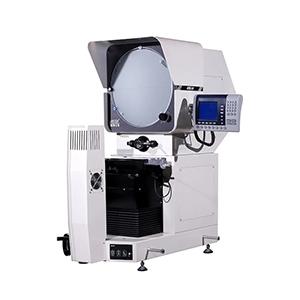
As a precision optical measuring instrument, the profile projector relies heavily on its metal stage, which serves multiple core functions including workpiece support, optical reference alignment, guide rail support and overall measurement stability. Even extremely small variations in the flatness of the stage are magnified significantly through the optical system, ultimately appearing as contour displacement or dimensional error. Understanding the mechanisms behind stage flatness errors is therefore fundamental to improving measurement stability and long-term reliability. The following provides an engineering-oriented systematic analysis of the major sources of flatness error in metal stages.
1. Machining and Manufacturing Errors
Metal stages are commonly made from cast iron, aluminum alloy or steel, and are produced through milling, grinding, scraping and other precision machining processes. Several factors during manufacturing directly determine the initial flatness.
1) Insufficient control over surface geometry
During milling or grinding operations, tool wear, variations in cutting force, insufficient machine rigidity or improper tool path planning can cause local waviness, doming or depressions. These deviations may be extremely small, but they are amplified significantly by the optical system and become observable contour distortions.
2) Deformation caused by clamping during machining
Multiple clamping steps are required during machining. If the clamping force is unstable or unevenly distributed, the stage may bend or warp slightly during processing. Although some elastic deformation recovers after unclamping, irreversible geometric changes often remain.
3) Incomplete release of internal stresses
Metal components typically retain residual stresses after casting, welding or rough machining. If heat treatment or stress-relief aging is insufficient, these stresses gradually release over time, resulting in slow deformation such as slight central bulging or edge lifting.
Machining and manufacturing errors form the initial basis of flatness deviation and play a critical role in the long-term accuracy of the projector.
2. Assembly-Induced Structural Deformation
The metal stage must be precisely assembled with guide rails, locating blocks, supporting columns and other structural components. Even small assembly deviations can affect flatness.
1) Insufficient flatness of mating surfaces
If the mounting surfaces for guide rails or support plates have slight height variation, tightening the bolts introduces local bending forces, causing subtle warping of the stage.
2) Uneven distribution of bolt preload
The preload applied to fasteners directly affects stress distribution in the stage. Excessive or overly concentrated preload can locally compress the surface, while uneven preload may cause the entire stage to tilt slightly.
3) Geometric error transmission from guide rail bases
The mounting bases of XY guide rails are precision elements. Any geometric deviation on these bases is transferred directly to the stage, creating a “forced deformation” that is difficult to detect but detrimental to measurement accuracy.
Assembly-induced errors occur at the beginning of the equipment’s life cycle and remain constant, making assembly quality a major determinant of overall flatness.
3. Micro-Deformation Caused by Long-Term Load
Although metal stages have high rigidity, prolonged use can still introduce small, irreversible deformations due to uneven loading.
1) Local subsidence caused by uneven workpiece distribution
If workpieces, fixtures or clamps are repeatedly placed in the same area, the concentrated load gradually creates localized subsidence. This deformation accumulates slowly yet irreversibly.
2) Fatigue stress from repetitive loading
Repeated measurement operations impose cyclic loads on the same regions. Over time, internal stresses redistribute, causing minor geometric changes in the stage.
3) Stress migration caused by environmental vibration
In factories with significant floor vibration, continuous micro-vibration accelerates the release of internal residual stress, eventually leading to slight bending or warping.
These long-term load-induced errors often become apparent only after months or years of use.
4. Thermal Deformation Caused by Temperature Gradients
Metal exhibits notable thermal expansion. When different areas of the stage experience different temperatures, bending or warping inevitably occurs.
1) Local heating from light sources and electronics
Illumination lamps, control boards and motors generate heat. If heat dissipation is uneven, localized thermal expansion causes upward bowing or slight warping.
2) Uneven environmental temperature changes
Direct airflow from air conditioners, proximity to windows or unstable local temperature zones can induce front-to-back or left-to-right temperature gradients, resulting in micro-deformation.
3) Instantaneous deformation caused by temperature differences between workpiece and stage
If a workpiece is significantly warmer than the stage, localized heat transfer produces short-term deformation that directly affects measurement repeatability.
Temperature-gradient-induced errors are dynamic and vary with operating conditions, making them a critical factor in high-magnification optical measurement.
5. Influence of Support Conditions and Material Characteristics
The stability of the stage geometry is closely tied to its support design, structural layout and material properties.
1) Support configuration affecting overall deformation
The number, position and tightening method of support points determine how stress is distributed:
Three-point support provides high stability but is sensitive to load distribution.
Four-point support offers stronger capacity but is prone to over-constraint deformation.
If the support system design is inadequate, deformation may occur even if initial flatness is good.
2) Internal structural variations of metal materials
Metal materials may contain microscopic defects such as uneven grain structure, density variation or micro-voids. Under long-term load and temperature cycling, these factors contribute to subtle deformation that cannot be eliminated entirely by machining.
3) Insufficient rigidity of the machine frame
The stage is mounted onto a machine frame. If the frame lacks rigidity or the mounting surface is uneven, the stage may bend or twist together with the frame, affecting overall flatness.
Flatness error in profile projector stages is not caused by a single factor but by the combined effects of machining, assembly deviation, long-term loading, temperature gradients and support conditions. Understanding these mechanisms enables engineers to optimize structural design, improve manufacturing and assembly control, and implement appropriate maintenance strategies. This ensures that the stage maintains stable geometric characteristics over long periods, thereby guaranteeing measurement accuracy and reliability.